


The central Maldives can feel overwhelming on a first visit: 26 atolls, hundreds of resorts, and more than 200 local islands spread across the Indian Ocean. Yet with smart planning, it is possible to combine a classic overwater-villa stay, time on an inhabited island, and world-class marine encounters in a single itinerary, without losing days to long transfers or blowing the budget on seaplanes. This guide focuses on realistic 5, 7, 10 and 14 day routes through the central atolls, built around concrete resort and local-island pairings and the speedboat, seaplane and domestic-flight logistics that actually work on the ground.
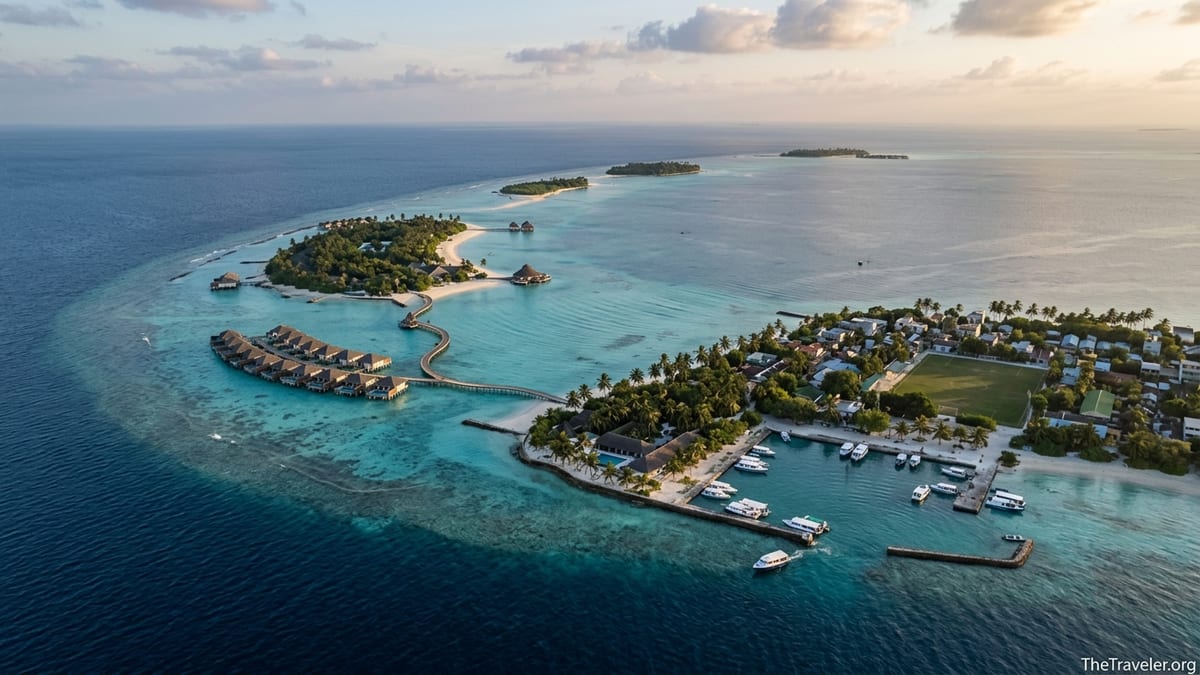
How Central Atolls Fit Together: A Quick Orientation
When travelers talk about the “central Maldives,” they are usually referring to the atolls within practical reach of Velana International Airport near Malé: Kaafu (North and South Malé), Ari (split into North and South Ari), Vaavu and sometimes Dhaalu. These atolls form a loose arc south and west of the capital and host both some of the country’s busiest resort clusters and several of its most accessible local islands, including Maafushi and Fulidhoo in Kaafu and Vaavu, and Dhigurah and Thoddoo in Ari. Speedboat, seaplane and domestic-flight routes fan out from Malé, and understanding these is the key to building a smooth multi-stop itinerary.
For a first or second visit, Kaafu and Ari make a particularly efficient pairing. Kaafu offers fast speedboat access from the airport to both resorts and popular local islands such as Maafushi and Gulhi, so you can be on the beach within an hour of landing. Ari, reached either by seaplane or a combination of domestic flight and speedboat, is famous for year-round whale sharks in South Ari and strong channel diving in North Ari. Vaavu, directly south of Malé, adds a quieter, more traditional feel and reliable nurse shark encounters around the small local islands of Fulidhoo and Keyodhoo. Together these three atolls provide enough variety in just a week, yet remain compact enough that you do not spend more time in transit than in the water.
Transfers shape your itinerary as much as your choice of resort. Speedboat-only routes out of Malé are usually the simplest and cheapest: many Kaafu and Vaavu islands offer shared speedboat transfers that cost roughly the same as two or three taxi rides in a major European city per person each way. Seaplanes, used for a number of Ari and Dhaalu resorts, offer a stunning bird’s-eye view and save time but can easily rival or exceed a budget airline ticket for a short-haul flight. Domestic flights, such as Malé to Maamigili for parts of South Ari, often sit in the middle on price and run even in low light or poor weather, which makes them practical for shoulder-season travel.
Choosing Your Bases: Resorts and Local Islands That Pair Well
The most efficient central Maldives itineraries are built around pairs or trios of islands that share a transfer corridor. One classic combination for a short trip is Maafushi or Gulhi in South Malé Atoll plus a nearby speedboat-accessible resort. Maafushi, around 25 to 35 minutes by speedboat from the airport, is one of the country’s most developed local islands, with dozens of guesthouses, dive shops, and day-trip operators. It is busy and social rather than secluded, but that density keeps prices competitive and makes it easy to arrange excursions to sandbanks, snorkeling reefs and even resort-day passes. A nearby resort such as Adaaran Club Rannalhi or a slightly higher-end property like Anantara Dhigu, reachable by shared speedboat in 30 to 45 minutes from Malé, slots neatly onto either the front or back of a Maafushi stay.
Travelers who want a quieter local island but still efficient logistics often look at Fulidhoo in Vaavu Atoll or Thoddoo and Ukulhas in Ari. Fulidhoo, roughly 1 hour 15 minutes from Malé by scheduled speedboat, is known for its intimate feel, compact bikini beach and easy access to nurse shark and ray snorkeling sites. Thoddoo, in North Ari, combines long white beaches with a more agricultural landscape, with watermelons and papayas grown in the island’s interior. These islands pair well with central or western Ari resorts that use the same seaplane routes, for example mid-range properties clustered around South Ari that can be reached in 25 to 35 minutes by seaplane followed by a short boat transfer.
If your priority is marine life, consider a base on a local island such as Dhigurah in South Ari, which offers one of the longest bikini beaches in the country and frequent whale shark excursions, plus a nearby resort that can be visited either as an overnight stay or with a day pass. Local guesthouses in Dhigurah typically cost a fraction of a private resort villa, and boat trips for whale shark or manta snorkeling are sold as small-group outings. You can then add one or two nights at a resort either in Ari itself or back near Malé, choosing properties that advertise speedboat or seaplane transfer times aligned with your arrival and departure flights.
5-Day Central Maldives: A Taste of Both Worlds
A 5-day itinerary leaves little room for complicated transfers, so the most practical strategy is to stick to speedboat routes from Malé. One efficient pattern is to begin with three nights on a local island followed by two nights at a nearby resort. For example, you could arrive at Velana International Airport, clear immigration, and board a prebooked afternoon speedboat to Maafushi. After three nights there, with day trips to house-reef snorkel sites, dolphin cruises and perhaps an evening sandbank barbecue, you return by speedboat toward Malé but transfer at the resort jetty for two nights at a close-by island such as Adaaran Club Rannalhi or another South Malé resort that offers short transfers.
Logistically this 5-day route keeps all legs under about 45 minutes on the water. Speedboat transfers are normally booked through your accommodation, with shared shuttles running at set times and private charters available for late-night arrivals at a premium. Typical shared-speedboat costs on these popular routes are often comparable to a short regional flight for two people, so building your itinerary around a single corridor avoids paying twice for widely separated atolls. On departure day, the resort speedboat takes you directly back to the airport jetty in time for check-in, and many properties are accustomed to arranging early-morning transfers for flights leaving before midday.
An alternative 5-day option is to skip the resort stay altogether and spend your entire time on one local island with a rich excursion menu. Fulidhoo in Vaavu or Dhiffushi in North Malé both offer snorkeling, sandbank picnics and easy access to nearby reefs, plus the option of day passes to surrounding resorts. In this model you might arrive and depart by the same shared speedboat, minimizing logistics and maximizing time in the water, while still getting a glimpse of resort-style beaches and facilities on a one-day visit.
7-Day Routes: Classic Split Stays Across Two Atolls
With a week to play with, you can afford either a simple two-stop split or a slightly more ambitious three-stop route, provided you cluster your islands. One popular 7-day pattern is three nights on a local island in South Malé Atoll, two or three nights at a nearby resort, and one final night near Malé or Hulhumalé to remove the stress of early flights. In practice this might look like three nights on Gulhi or Maafushi, followed by two nights at a resort reached by speedboat from the same harbor, then a final night at a hotel in Hulhumalé that offers a short car transfer to the airport. This ensures that even if weather disrupts boat schedules, you are on the “right” side of the atoll the night before departure.
Travelers more focused on wildlife might use a 7-day window to combine Kaafu with Ari. One workable route is to start with two nights in or around Malé to adjust after a long-haul flight, then take a seaplane or domestic flight onward to a South Ari base such as Dhigurah or a nearby mid-range resort. You would then spend four or five nights in Ari, using one of the days for a full-day whale-shark excursion and another for manta or reef snorkeling. On your final day you fly back to Malé, perhaps with a few hours to spare in Hulhumalé before your international departure.
When mixing seaplanes and speedboats in a 7-day itinerary, timing is critical. Seaplanes typically operate only in daylight and are sometimes grouped into waves based on international arrivals; your resort or guesthouse will give you a transfer window rather than an exact time. It is wise to avoid very late-night arrivals if you need a seaplane the same day, and equally wise to schedule a final night within speedboat distance of the airport if your homeward flight leaves early in the morning. Keeping one buffer night in Kaafu at either the start or end of your trip gives you breathing space if a domestic flight or seaplane is delayed.
10-Day Central Maldives: Deeper Into Ari, Vaavu and Beyond
Ten days allows enough time to see two distinct sides of the central Maldives without constant packing. A practical 10-day plan might combine a quiet local island known for marine life with both a mid-range resort and a more budget-friendly guesthouse in a different atoll. One example would be three nights in Dhigurah in South Ari for whale sharks, four nights at a nearby resort in the same atoll, and three nights on a simpler local island such as Fulidhoo in Vaavu or Thoddoo in Ari on the way back toward Malé. This way, your longest transfer is the initial hop from Malé to Ari, which can be done by seaplane or domestic flight plus speedboat, and the rest of your travel is within a more compact region.
To make this 10-day structure work, look closely at transfer options before locking in accommodation. Some Ari resorts share seaplane routes with local islands that have their own small harbors, while others rely on private charter boats from a domestic-airport island. In practice, many travelers choose to either stay all 10 days within one atoll or to pair two atolls that share good boat connections. For example, South Ari and Vaavu can be linked by speedboat via Malé without needing an additional domestic flight, which means you can move from a South Ari base back toward a Vaavu local island and then on to the airport along existing lines.
Budgeting over 10 days also benefits from a clear understanding of nightly prices. Local guesthouses on islands such as Dhigurah, Thoddoo and Fulidhoo often start in the low to mid double digits per night for simple double rooms, especially outside peak festive dates, while mid-range resorts in the central atolls can easily run into the high hundreds per night depending on board basis and villa type. Using a “ladder” structure where you spend the longest stretch on a local island, a shorter stretch at a resort, and perhaps a final night in a simple airport hotel usually keeps the overall cost more manageable than spending the majority of the trip in a private villa.
14-Day Grand Circuit: A Three-Atoll Exploration
With two full weeks you can comfortably design a central Maldives route that includes multiple atolls and both local and resort stays, provided you respect the transfer grid. One realistic 14-day “grand circuit” would focus on Kaafu, Vaavu and Ari. You might start with three nights on a Kaafu local island such as Thulusdhoo or Maafushi to adjust to the climate and time zone, using shared speedboats from the airport. Then you would move south by speedboat to a quieter island in Vaavu, perhaps Fulidhoo, for four nights of reef snorkeling, sandbank picnics and nurse shark encounters. From there you would return to Malé by speedboat and connect to a seaplane flight to a resort in South Ari for five nights, ending with two nights in Hulhumalé for logistical buffer and some low-key urban exploring.
This type of 14-day itinerary works because each leg follows an existing route that the islands already use for supplies and passenger transfers. Kaafu and Vaavu are linked by multiple scheduled speedboats, while the jump from Malé to Ari is among the busiest seaplane corridors in the country. You avoid trying to move directly between far-flung atolls that are only practically connected via the capital, and you keep your overnight stops to a manageable four or five. The result is a trip that feels varied and adventurous, yet still retains the classic Maldivian rhythm of sunrise swims, lazy midday hours in the shade, and long evenings under the stars.
Over two weeks you can also experiment with different accommodation styles. Some travelers choose to spend their central segment in Ari at a mid-tier resort with both beach and overwater villas, perhaps upgrading to an overwater category for the final two nights. Others opt for a hybrid approach, booking a couple of nights at a very high-end property within easy reach of Malé and using local islands for the bulk of their stay. The extra time allows for slower days with no fixed activities, which are often when you will notice small but memorable details: fishermen mending nets on the jetty, children playing football at sunset, or the glow of bioluminescent plankton in the shore break on moonless nights.
Making Transfers Work: Speedboat, Seaplane and Domestic Flight Logistics
Central Maldives itineraries live or die on logistics. Before paying any deposit, confirm exactly how you will move between each island, who arranges it, and what it costs. For speedboats, ask whether your guesthouse or resort uses scheduled shared transfers or private charters. Scheduled boats to popular local islands such as Maafushi, Thoddoo, Fulidhoo and Dhigurah typically run once or twice a day in each direction, with times adjusted slightly to match incoming flights. Private charters offer more flexibility, especially for late-night arrivals, but their cost can climb quickly once you factor in fuel and crew for an hour or more at sea.
Seaplane transfers, commonly used for resorts in Ari and some neighboring atolls, are usually booked only through the resort itself. The price is typically quoted per person for a return trip and often must be paid in advance along with your room. Seaplanes operate only in daylight and may not run in very poor visibility, so if you book an evening international arrival it is common to spend your first night at an airport hotel in Hulhumalé and take the seaplane the next morning. Domestic flights on larger aircraft, for instance between Malé and Maamigili for parts of South Ari, can be more forgiving in bad weather and often offer more fixed schedules, though they still require coordination with onward speedboat legs.
One subtle but important logistical point is “crossing the grid” between different transfer types. If you are moving, for example, from a Vaavu local island reachable only by speedboat to a South Ari resort reliant on seaplanes, you will almost always have to pass back through Malé in the middle. This consumes several hours and can sometimes require an overnight if international and domestic schedules do not align. Building your itinerary so that you cluster islands using the same transfer type and general direction reduces lost time and extra hotel nights. It can also provide peace of mind, especially in the wet season when afternoon storms occasionally delay or cancel flights.
Costs, Seasons and Practical Considerations
Central Maldives prices vary considerably by season, island type and board basis. Festive periods and school holidays see the highest resort rates, especially for overwater villas and all-inclusive packages. Local islands remain relatively more stable on nightly prices but see higher occupancy and busier beaches at these times. Shoulder months often deliver a sweet spot of calmer seas, good visibility and slightly more approachable rates, particularly for stays that include both local and resort nights. When comparing options, make sure you understand whether quoted prices include taxes, service charges and transfer costs, as these can add a significant percentage to the base room rate.
Weather shapes both itineraries and expectations. The Maldives sits in a tropical monsoon zone, with a drier season typically running from late December into April and a wetter season with more frequent showers and occasional storms from around May into October. Even in the wetter months many days are a mix of sunshine and short downpours, but seas can be choppier, which affects speedboat comfort and sometimes seaplane schedules. Central atolls such as Kaafu, Ari and Vaavu are popular year-round precisely because their transfer routes and marine-life patterns are relatively resilient to seasonal shifts, with South Ari offering whale sharks in most months and reef snorkeling accessible in virtually all conditions short of a major storm.
On local islands, travelers should also consider cultural norms and modesty expectations. Bikini beaches are clearly marked, and swimwear outside these zones should be more conservative. Alcohol is not served on inhabited islands, although “floating bars” anchored outside some harbors offer licensed service reached by small shuttle boats. Resorts, by contrast, operate under different regulations and generally serve alcohol widely, with the trade-off that you are separated from everyday local life. Splitting time between the two environments is not only a logistical strategy; it is also a way to experience both the international-resort side of the Maldives and the rhythms of village life that continue beyond the palm-fringed postcard views.
FAQ
Q1. Is it realistic to combine a resort and a local island in just 5 days?
Yes, if you keep to one transfer corridor. A common pattern is three nights on a local island such as Maafushi or Gulhi and two nights at a nearby speedboat-accessible resort, all within about 45 minutes of Malé, which minimizes time lost in transit.
Q2. How far in advance should I book seaplane and domestic-flight transfers?
Once you confirm your accommodation, book transfers immediately through the resort or guesthouse, as they control the reservations. Seaplane seats can fill during peak seasons, and domestic flights may have limited frequencies, so securing your spot early helps avoid awkward overnight layovers in Malé.
Q3. Are speedboat transfers safe and comfortable for children or nervous sailors?
Speedboats on the busy central routes are generally modern and well run, but conditions vary with the weather. Families with young children or travelers prone to seasickness may prefer shorter routes in Kaafu, schedule boats for mornings when seas are often calmer, and sit toward the rear where motion can feel slightly less intense.
Q4. Can I visit a resort as a day trip from a local island instead of staying overnight?
Yes, many resorts near central local islands offer paid day passes that include return boat transfers, lunch and limited use of facilities like pools and beaches. This can be a cost-effective way to experience a private-island setting while keeping most of your nights on a more affordable local island base.
Q5. How do I manage luggage when changing islands multiple times?
Most speedboat and seaplane operators in the central Maldives are used to travelers with checked-size suitcases and dive gear, but space is not unlimited. It is practical to travel with one main bag and a small daypack, keep valuables and essentials with you during transfers, and confirm any seaplane weight limits with your resort before arrival.
Q6. Is it possible to dive and snorkel independently from a local island?
Snorkeling directly from the beach or jetty is common on local islands with good house reefs, though currents can be strong and it is wise to ask local advice. For more distant reefs and channels, licensed dive centers and excursion operators provide boats, guides and safety briefings, which is the recommended approach even for experienced divers unfamiliar with Maldivian conditions.
Q7. How much should I budget per day on a local island compared with a resort?
On a central local island, many travelers find that modest guesthouse rooms, simple restaurant meals and a couple of excursions can often be covered on a mid-range daily budget for two. At a resort in the same region, nightly rates and on-site prices can be many times higher, especially once you add in taxes and service charges, so structuring your itinerary with more nights on local islands generally keeps overall costs down.
Q8. Do I need to book all my excursions in advance?
For high-demand activities like whale shark trips in South Ari during peak season, prebooking through your guesthouse or resort is sensible. For more routine excursions such as sunset cruises, house-reef snorkeling or sandbank picnics around Kaafu and Vaavu, there is usually enough capacity to arrange them after arrival, which also lets you pick days with better weather.
Q9. What is the best time of year for a multi-atoll itinerary in the central Maldives?
Many travelers favor the drier months from around January through April for calmer seas and more reliable sunshine, which helps when you have multiple speedboat and seaplane legs. That said, central routes operate year-round, and flexible travelers often find good value and fewer crowds in the shoulder months on either side of the traditional high season.
Q10. Is travel insurance important for a central Maldives trip with several transfers?
Yes, comprehensive travel insurance that covers missed connections, weather-related delays and medical care is strongly recommended when your itinerary involves several islands and transfer types. If a seaplane or domestic flight is postponed, having coverage for additional accommodation, meals and rebooked flights can significantly reduce stress and unexpected costs.