


Noonu Atoll in the northern Maldives has quietly become one of the most interesting places in the country to choose a resort. Within a short seaplane hop of each other you now find some of the world’s most exclusive private islands, ambitious all-inclusive playgrounds with water parks and beach clubs, and more conventional five-star properties that offer strong value without skimping on the essentials. Having stayed at or meaningfully inspected several of the region’s headline resorts over repeated trips, I found that choosing where to stay here is less about chasing a simple “best hotel” and more about matching the right island style to your budget, privacy expectations and travel logistics.
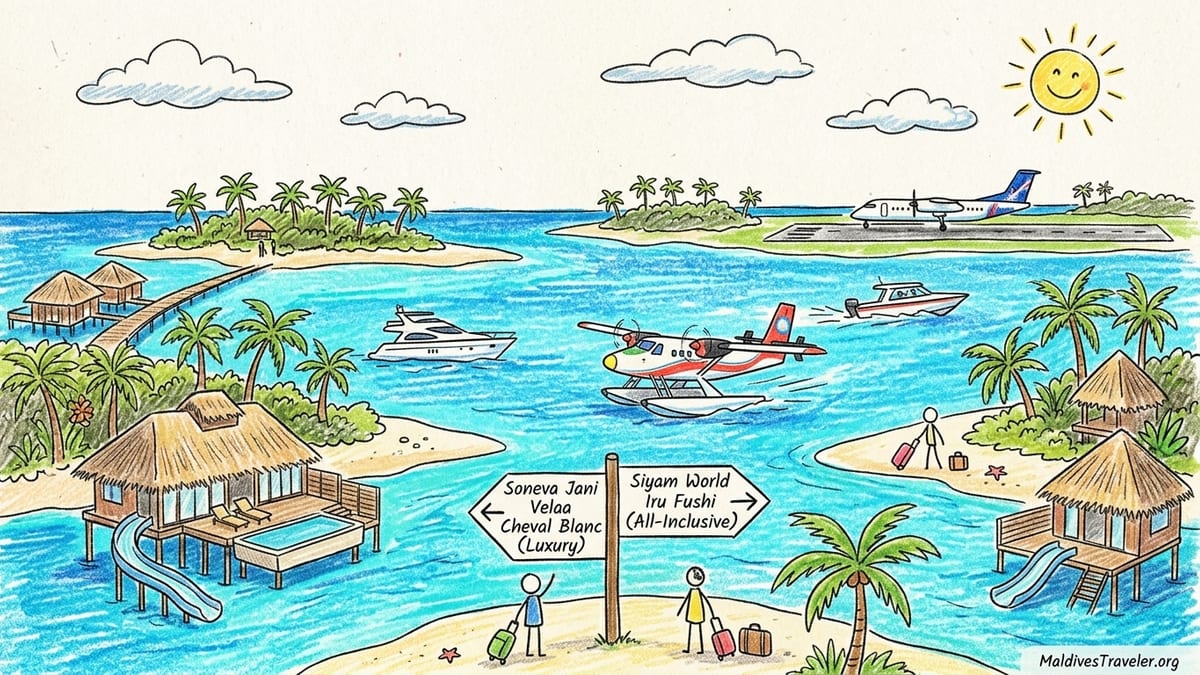
Understanding Noonu Atoll and How Transfers Really Work
Noonu Atoll lies roughly 40 to 45 minutes north of Malé by seaplane. Most international visitors land at Velana International Airport and then connect onward by resort-arranged transfer. For Soneva Jani, Velaa Private Island, Cheval Blanc Randheli, Siyam World and Sun Siyam Iru Fushi, that usually means a daytime seaplane flight; for some, it can also mean a combination of domestic flight to nearby Maafaru plus speedboat or yacht. In practice, seaplanes rarely run after sunset, so if your long-haul flight lands in Malé late in the afternoon, you may need a night near the airport or to accept an overnight flight that arrives early in the morning so you can connect straight to Noonu.
On my most recent visit, I routed through Malé in the early afternoon and still made it to Velaa Private Island before sunset, but only because the resort arranged an efficient transfer slot on its preferred seaplane service. Velaa can also route guests via Maafaru International Airport followed by a short seaplane hop of about seven minutes or a 30 to 35 minute yacht ride, which can be useful for private jet arrivals and for those who dislike small planes. Soneva Jani operates its own branded seaplane for extra privacy as well as using seats on the local carrier; the resort’s 2026 public rates show a private Soneva seaplane charter priced around 9,500 US dollars per way for up to nine guests, a reminder that transfer costs can rival business-class flights if you opt for full privacy.
Cheval Blanc Randheli uses a dedicated Cheval Blanc seaplane for the roughly 40 minute run from Malé to the resort’s lagoon, so the journey already feels like part of the brand experience. By contrast, Sun Siyam Iru Fushi and Siyam World use shared seaplane transfers arranged through their operators, which are more economical but involve brief stops at neighboring islands. When I stayed at Iru Fushi, my seaplane paused at another resort for a quick drop-off, adding perhaps ten minutes but reducing the per-person transfer cost substantially compared to ultra-luxury options. For most travelers, a shared seaplane will be perfectly comfortable; the premium services mainly matter if you want full privacy, guaranteed schedules, or a branded cabin that matches the resort’s aesthetic.
Transfer complexity should be part of your decision, especially if you travel with young children or if you are sensitive to tight connections. If you are combining islands, it is worth asking in advance about inter-resort transfers. Soneva, for instance, periodically offers complimentary or discounted boat transfers between its properties when you split your stay, while properties in Noonu may be able to organize direct speedboats between neighbors such as Velaa and nearby five-star resorts. These arrangements are not always published and can shift from season to season, so I recommend confirming concrete costs and schedules before locking in flights.
Soneva Jani: Lagoon Dreaming and Maximum Privacy
Soneva Jani is the name that comes up first whenever someone mentions Noonu Atoll and ultra-luxury. Set on a long, low island with a vast shallow lagoon, the resort is best known for its oversized overwater villas, many with slides that drop from the upper deck into the lagoon. Walking into a Chapter 2 water retreat for the first time, the immediate impression is space and seclusion: high ceilings, pale wood, enormous decks and, crucially, no neighboring villas looking back at you. From my villa’s pool I could watch reef sharks cruising the shallows with no other structure in sight, which is something even many five-star Maldivian resorts cannot offer.
In privacy terms, the newer overwater villas in Chapter 2 and the larger Chapter 1 units at the far ends of the jetties feel particularly secluded. Decks are staggered so that you are not staring into the neighbors’ plunge pools, and the sheer width of the lagoon means that boat traffic stays well away from guest areas. Beach villas, which Soneva added more recently, have thick vegetation buffers and direct sand access; they feel more connected to the island but still screened. For guests who prefer to avoid curious drones or passing boats, it is worth mentioning this preference during booking so the resort can place you at the quieter ends of the jetties.
Where Soneva Jani differs from many Maldivian islands is the emphasis on experiences and dining choice rather than a single signature restaurant. The resort runs multiple small venues and pop-ups, from plant-based fine dining to a cheese room, chocolate room and complimentary ice-cream parlor. Meal plans for 2026 and 2027 clearly state that half board covers breakfast and dinner food but not in-villa dining, which is charged separately. That matters once you start ordering sushi and champagne to your deck most evenings. I have seen couples arrive thinking an inclusive plan meant unlimited room service and then adjust their habits after seeing the first night’s bill. If you plan on many in-villa meals, build that into your budget from day one.
Soneva Jani’s lagoon is picturesque, but it is not a classic drop-off house reef. For snorkeling, the resort runs regular boat trips to outer reefs and nearby pinnacles, and the on-site marine team is excellent at tailoring outings to your comfort level. Children are well looked after through the Den kids’ club, one of the largest in the country, with everything from zip-lines to a mini water park. When I toured the facilities, what impressed me most was how many activities were genuinely creative rather than just screen time: glass-blowing sessions, astronomy evenings at the observatory and guided eco workshops. Excursions such as dolphin cruises and sandbank picnics carry premium pricing in line with the rest of the resort. It is common for a family’s extras here to run into several hundred dollars per day even on a meal plan, so Soneva Jani makes sense for those who prioritize space and concept-driven luxury over strict budget control.
Velaa Private Island: A Boutique Fortress of Quiet Luxury
Where Soneva Jani is playful and spread out, Velaa Private Island feels small, intense and deliberately low-key. With around 47 villas, houses and residences, Velaa is one of the most exclusive resorts in the Maldives in terms of room count and available space per guest. The architecture forms a subtle turtle motif when viewed from above, but on the ground the dominant impression is of thick palm groves, curved sandy paths and villas spaced far enough apart that you can live an entire week here and rarely encounter anyone outside the restaurants and main pool.
Villa privacy at Velaa is among the best I have experienced. Beach pool villas sit behind high hedges and dense greenery with private gates leading to narrow strips of powder-soft sand. From my beachfront pool I could see the ocean but not the neighbors, and passing staff were discreet, using the rear service paths instead of walking along the beach. Overwater villas angle outward from the island, with plunge pools and lounges facing the channel rather than each other. For those who want maximum seclusion, the larger residences such as the four-bedroom Nika or the romantic pool residences at the tip of the pier offer the feeling of a private home with full butler service.
Velaa’s house reef is accessible, but the resort is more about curated experiences than do-it-yourself snorkeling from your villa. The on-site water sports center offers everything from paddleboards and jet skis to a semi-submarine and one of the more serious golf academies in the Maldives. Divers head out by boat to nearby sites in Noonu, and visibility during my stay was excellent, with eagle rays and turtles common. The kids’ club, created with the owner’s daughter in mind, has an outdoor splash area, child-sized sun loungers and a schedule that runs from simple crafts to cooking sessions; during school holidays it can feel almost like a small international school on the beach.
Dining here is intentionally elevated. Aragu, the main fine-dining restaurant, delivers European-inspired tasting menus that would not feel out of place in a major city, while Tavaru, set in a striking tower, combines teppanyaki with one of the largest wine collections in the country. The average dinner for two with wine at Aragu can easily edge towards 600 to 800 US dollars, which gives a sense of the overall cost structure. There is no true all-inclusive plan. When you add in spa treatments, golf lessons, motorized water sports and premium transfers, Velaa is in the very top tier globally for daily spend. For guests who value quiet, under-the-radar privacy, discreet service and serious gastronomy, however, it justifies that price in a way that larger, busier islands often cannot.
Cheval Blanc Randheli: Design-Forward Island Hopping
Cheval Blanc Randheli, part of the LVMH portfolio, occupies several interconnected islands in a large lagoon in Noonu Atoll. The property combines 46 or so villas with a spa island, staff island and an ultra-exclusive private island residence, connected by short boat rides. The effect is of a design-forward archipelago rather than a single island, and it shapes the experience: you move between beach villa, main pool, spa and restaurants by boat or along long jetties, which some guests find enchanting and others occasionally find time-consuming.
Beach, garden and water villas all feature private pools and generous outdoor living areas. Beach villas in particular offer strong privacy with walled gardens, shaded terraces and direct sand access. During my inspection, the foliage between neighboring villas felt dense enough that even with occupancy rising for the festive season, you had little sense of a crowd. Overwater villas line a curved jetty with plunge pools facing the open lagoon. From a privacy perspective these are slightly more exposed to passing boats than Velaa’s or Soneva’s most secluded units, but careful placement and setbacks keep sightlines limited. The separate four-bedroom private island, reached by a very short boat ride, functions almost as a private estate with its own jetty, butler team and standalone facilities.
Cheval Blanc Randheli’s dining program is one of its major draws. There are five restaurants and three bars, including a signature French fine-dining venue, Le 1947, a Mediterranean overwater spot and an Asian-fusion restaurant with teppanyaki. Dining is fully a la carte; even half-board style inclusions that some tour operators offer usually involve set credit, and the resort’s own materials emphasize that restaurants and 24-hour Carte Blanche in-villa dining are charged separately. That matters because meals here are priced close to top European city levels; it is common for a family of four to spend several hundred dollars a day on food and non-alcoholic drinks even before adding wine.
The spa, operated in partnership with Guerlain, occupies its own island with overwater treatment pavilions, which are as much about setting as they are about treatments. For families, the Carrousel kids’ club and teen space offer structured activities and supervised play, which, coupled with two-bedroom villa options, make Randheli a viable choice for multi-generational trips. The house reef is pleasant but not dramatic; serious snorkelers and divers will still want boat trips to outer reefs. In my experience, guests choose Randheli less for marine intensity and more for the blend of design, service and culinary polish, along with the convenience of the brand’s dedicated seaplane, which whisks you from Malé to the resort in about forty minutes.
Siyam World: High-Energy All-Inclusive Playground
Siyam World sits on a sizeable island in Noonu Atoll and has a very different personality from its ultra-luxury neighbors. This is a large resort by Maldivian standards, with hundreds of villas, multiple pool areas and a claim to one of the biggest floating water parks in the region. Walking down the main beach at sunset during my stay, I saw groups playing beach volleyball, live music gearing up at a bar, and children pleading for one more ride down the slides; it felt closer to a beach club resort in Thailand than to the hushed seclusion of a boutique private island.
Accommodation at Siyam World runs from basic beach villas up to overwater units with slides and multi-bedroom residences. Villa privacy varies widely. The most affordable beach categories sit relatively close together with thinner vegetation between terraces, which means you will likely see and hear your neighbors. Higher categories and those at the quieter ends of the island are more shielded. Overwater villas angle away from each other, but given the density, you should expect to see people walking along the jetties and using the shared lagoon space. This is not the resort to choose if you want to skinny-dip unseen, but it can be exactly right if you want your children to find friends easily and do not mind a sociable atmosphere.
The all-inclusive concept here is the central selling point. Packages typically include meals at several buffet and a la carte venues, a range of alcoholic and non-alcoholic drinks by the glass, and access to many activities. When I compared sample packages for shoulder season dates, nightly rates for a family in a water villa with pool and slide were often less than the cost of a single entry-level overwater villa at Soneva Jani or Velaa on a room-only basis. Extras still exist, such as premium spirits, certain specialty restaurants, motorized water sports and off-island excursions, but the proportion of your final bill taken up by surprises tends to be lower.
The house reef around Siyam World offers decent snorkeling from some points, but sections are more about a sandy lagoon for swimming and water sports. The resort organizes boat trips to better reefs, and there is a strong emphasis on fun rather than hardcore diving. Children’s facilities include a kids’ club, the large floating water park and family-friendly pools. In practice, families with energetic kids who want slides and shallow swimming options tend to be very happy here, while honeymooners seeking silence quickly realize they would be better off at a smaller property. If you are comparing Siyam World with traditional five-star islands in Noonu, consider whether you value having many bars and activities within walking distance or whether you would happily trade that busyness for a quieter, more spread-out layout.
Sun Siyam Iru Fushi and Mövenpick Kuredhivaru: Classic Five-Star Choices
Sun Siyam Iru Fushi and Mövenpick Resort Kuredhivaru represent the more conventional five-star segment in Noonu Atoll. Both offer a familiar Maldivian format of beachfront and overwater villas, multiple dining venues and a mix of couples’ and family facilities, but at prices significantly below Soneva, Velaa or Cheval Blanc. For many travelers, these islands strike the most realistic balance between comfort, amenities and total trip cost.
Sun Siyam Iru Fushi sits on a medium-sized island with 200-plus villas distributed between thickly vegetated inland paths and open lagoon jetties. During my stay, entry-level beach villas offered comfortable interiors and shaded patios, but privacy depended on location. Villas closer to the main jetty and pool saw more foot traffic along the beach, while those tucked further along the shoreline felt quiet and more shielded by palms. Overwater villas faced either the sunrise or sunset, with small plunge pools and ladders into the lagoon. The island’s beaches were broad and soft, with family-friendly shallows near the main pool and quieter coves near the dive center.
Iru Fushi’s dining is a strong point for its category, with around a dozen bars and restaurants that rotate opening days to manage occupancy. During one week I ate at a beach grill with Maldivian seafood, a Mediterranean overwater restaurant and a pan-Asian spot, all of which delivered enjoyable, if not Michelin-chasing, meals. The resort offers both bed-and-breakfast and more inclusive plans; in practical terms, moving from breakfast-only to an all-inclusive option can add a few hundred dollars per night for a couple, but will cover buffet meals, selected a la carte dishes and house drinks. When I compared itemized bills with and without packages, couples who enjoy cocktails by the pool and full three-course dinners often came out ahead on all-inclusive, while light eaters preferred the flexibility of paying as they go.
Mövenpick Kuredhivaru, reached by similar seaplane routes, has a smaller footprint than Iru Fushi and fewer villas. The layout emphasizes overwater pool villas in particular, which feel private and modern but sit relatively close together along the jetty. Beach villas front a good strip of sand with clear water for swimming, and there is a house reef accessible from set entry points rather than from every villa. Families benefit from the Little Birds kids’ club and a family-style pool, while couples gravitate towards the main infinity pool and the spa. Prices here, looking at publicly available packages, often fall between Iru Fushi and Siyam World, and special offers with half-board are common outside peak holiday dates.
Both Iru Fushi and Kuredhivaru offer a house reef experience that is enjoyable without being a hardcore diver’s dream. Coral recovery is visible in patches, and fish life around drop-offs can be rewarding if you swim a few minutes from shore. Excursions such as dolphin cruises, turtle snorkel trips and sunset fishing typically run from around 50 to 150 US dollars per person, depending on exclusivity. These numbers matter for your final bill: at a classic five-star island, it is entirely possible for a couple to keep total extras under 200 dollars per day with moderate bar use and one paid excursion, whereas at ultra-luxury islands the baseline spend on similar activities can be significantly higher.
Matching Resort Style to Your Budget and Travel Style
Choosing where to stay in Noonu Atoll ultimately means choosing your island personality and cost profile. On one end of the spectrum sit Soneva Jani, Velaa Private Island and Cheval Blanc Randheli, where seclusion and personalized service define the experience. Here, villa privacy is meticulous, from high garden walls and thick foliage to carefully oriented overwater decks. Beaches are groomed daily, guest numbers are low relative to island size, and dining aims for capital-city-level sophistication. The trade-off is that both the nightly rate and the hidden extras, from wine lists to private excursions, add up quickly. It is common for a couple in high season to see nightly charges that, once taxes, meals and activities are included, reach several thousand dollars even in entry-level categories.
At the other end are larger, more social resorts like Siyam World, where per-night headline rates under an all-inclusive plan can look surprisingly accessible for the Maldives. Here, you sacrifice some privacy and quiet in exchange for water parks, multiple pools, casual entertainment and the reassurance that most of your food and drink is prepaid. For many families, especially those with teenagers or children who thrive on activity, this trade feels not just acceptable but ideal. Parents can relax at the bar knowing that snacks, sodas and simple cocktails will not trigger bill shock at checkout.
In the middle sit classic five-star options such as Sun Siyam Iru Fushi and Mövenpick Kuredhivaru. These islands cannot match the artisan details or immense villa footprints of the ultra-luxury properties, but they deliver private pools, good beaches, balanced dining options and decent children’s facilities at a fraction of the total trip cost. For a honeymoon, a week at one of these resorts in a higher villa category with a smart meal plan can cost less than five nights in an entry-level overwater villa at Soneva or Velaa once you factor in transfers and extras. For a first-time visitor to the Maldives, especially one who wants to stay ten nights or combine Noonu with another atoll, this mid-range five-star segment is often the sweet spot.
When I help friends compare options, I ask a few practical questions. How much do you value seeing almost no one else on the beach or deck during the day. How sensitive are you to food and beverage costs beyond breakfast. Are the kids old enough to enjoy a serious kids’ club, or would they be happier simply having a water park and pizza on demand. Are you comfortable with a final bill that may double your original room-only quote if you fall in love with spa treatments and wine pairings. In Noonu Atoll, there is no single best answer, but there is likely a best island once you are honest about these trade-offs.
The Takeaway
Noonu Atoll has matured into one of the Maldives’ most compelling clusters of resorts precisely because it offers such different answers to the same basic question of where to stay. If you dream of cinematic overwater villas with near-total privacy, personalized butler service and destination restaurants, then Soneva Jani, Velaa Private Island or Cheval Blanc Randheli are your natural starting points, each with a slightly different personality. Soneva leans into playful sustainability and experience-driven luxury, Velaa into quiet, understated exclusivity, and Randheli into fashion-forward design and French-inflected gastronomy.
If, instead, you picture your Maldives trip as a high-energy beach holiday with water slides, evening entertainment and a bar you can wander up to without worrying about every line on the bill, then Siyam World is the kind of place that makes sense. Its all-inclusive focus and big-resort layout cater to families and groups who want to share a lot of activity. Somewhere between these poles, Sun Siyam Iru Fushi and Mövenpick Kuredhivaru give you the classic postcard version of the Maldives: white sand, turquoise lagoon, a private pool and a choice of restaurants, all at a scale and price that suits longer stays.
The key is to see Noonu not as a set of hotels to rank on a single list, but as a menu of island lifestyles. Once you have decided whether your priority is ultra-luxury seclusion, high-end but family-friendly comfort, a fully packaged all-inclusive or a well-priced five-star, the options narrow quickly and the choice becomes more manageable. With clear expectations about villa privacy, reef access, dining style, kids’ facilities, excursion budgets and transfer logistics, you can pick the island that fits not only your budget but also your rhythm. That, more than any ranking, is what will determine whether your Noonu Atoll stay feels like the right kind of escape.
FAQ
Q1. Is a seaplane transfer to Noonu Atoll worth the cost compared with a domestic flight and speedboat.
For most travelers, yes, because the direct seaplane saves time and offers a scenic arrival, but guests on private jets or with late-night flights may prefer routing via Maafaru with a shorter onward seaplane or yacht ride.
Q2. Which resort in Noonu Atoll offers the most privacy in its villas.
Among the properties discussed, Velaa Private Island and Soneva Jani stand out for villa spacing, dense vegetation and careful orientation, with Cheval Blanc Randheli’s beach and garden villas also offering strong privacy once inside their walled gardens.
Q3. How good is the house reef snorkeling at these Noonu Atoll resorts.
House reefs vary: some, like sections around Iru Fushi and Kuredhivaru, offer enjoyable but not world-class snorkeling, while lagoon-focused resorts such as Soneva Jani rely more on boat trips to outer reefs for the best underwater experiences.
Q4. Are all-inclusive plans in Noonu Atoll really good value.
At larger resorts such as Siyam World or certain packages at Sun Siyam Iru Fushi, all-inclusive plans can be good value for guests who enjoy regular drinks and full meals, but light eaters or those who prioritize ultra-luxury dining may prefer paying a la carte.
Q5. Which resorts in Noonu Atoll are best suited for families with young children.
Families often gravitate to Siyam World for its water park and inclusive concept, Sun Siyam Iru Fushi and Mövenpick Kuredhivaru for balanced facilities and kids’ clubs, and Soneva Jani, Velaa or Cheval Blanc Randheli when budget allows for more elaborate children’s programs and larger villas.
Q6. How expensive are meals at the ultra-luxury resorts compared with classic five-star islands.
At Soneva Jani, Velaa and Cheval Blanc Randheli, dinner for two with wine can easily reach several hundred dollars, while at Iru Fushi or Kuredhivaru, a comparable meal tends to be noticeably cheaper, especially under half-board or all-inclusive plans.
Q7. Do any Noonu Atoll resorts offer particularly easy transfer options for private jet arrivals.
Yes, Velaa Private Island and nearby resorts can route guests through Maafaru International Airport, followed by a very short seaplane hop or yacht transfer, which avoids the need to connect through Malé’s domestic terminal after a private flight.
Q8. Is it practical to split a stay between two resorts in Noonu Atoll.
It can be, especially if both resorts are in Noonu and can arrange a direct boat or short seaplane transfer between them, but exact options and costs depend on the properties involved and should be confirmed before booking flights.
Q9. How should I budget for extras like excursions and spa treatments in Noonu Atoll.
At classic five-star resorts, many couples find that 100 to 200 US dollars per day covers a moderate level of extras, while at ultra-luxury islands similar patterns of spa use, private excursions and premium drinks can raise that figure significantly.
Q10. For a first visit to the Maldives, is it worth paying for Soneva Jani or Velaa instead of a more affordable five-star resort.
It depends on priorities: if you value maximum space, privacy and cutting-edge dining and are comfortable with high incidental costs, they can be memorable first experiences, but many travelers are equally happy starting with a well-chosen five-star such as Iru Fushi or Kuredhivaru and saving the ultra-luxury islands for a special occasion.